
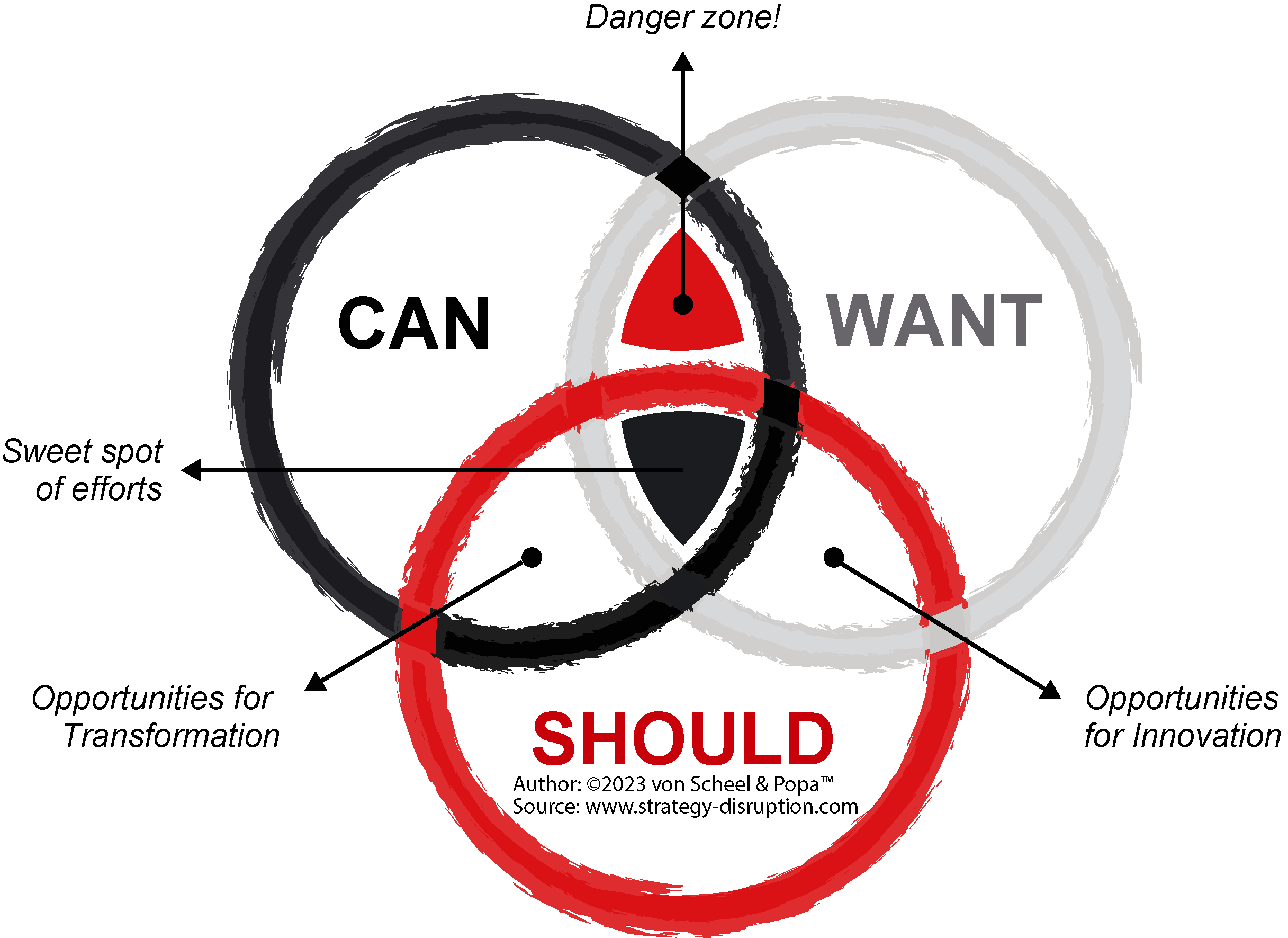
Can – Want – Should Do
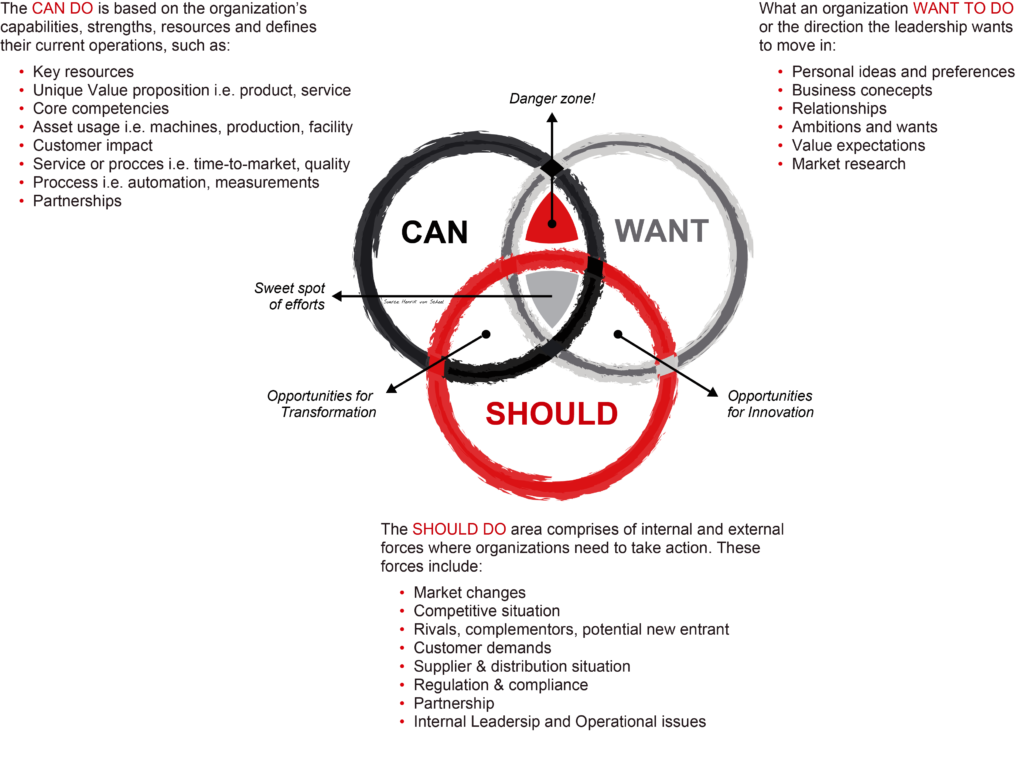
The CAN-WANT-SHOULD DO model is a proprietary graphical representation authored by Henrik von Scheel. Copyright registration: vyPnwCdqjAT4EN6D
Decision making Sequence patterns ofthe Outperformers
Why wasn’t Google created by Microsoft? Apple by Nokia? Skype by AT&T?
Why do established corporations struggle to find the next big thing before new competitors do? The problem is pervasive; the examples are countless
In researching the patterns (patternicity science) of the what the outperforming and underperforming organization did over the past 50 years, Henrik von Scheel has identify a sequence of situational, strategic and operational decision making patterns that the outperformers apply to constantly outperform the market – called the CAN-WANT- SHOULD DO model.
HOW TO READ AND USE IT?
1. Advanced Business Model Innovation. The CAN-WANT-SHOULD DO model structures a sequence thought process of what an organization CAN, SHOULD and WANT TO DO within each Business Model Domains i.e. Revenue Model, Service Model, Value Model, Cost Model, Performance Model and Operating Model.
2. Focus on the core. The important situational, strategic and operational thought process emphasize what the core focus area off what an organization CAN, SHOULD and WANT TO DO within each Business Model Domains. Thereby In this way manner, structuring the rare, but important discipline of thinking and working in business model that define future core differentiating aspects and competitive advantage.
To understand what the outperformers did differently in their Business Model Domain Map thoughts process, we examined 1800 CEOs and 3000 business leaders and mapped the different scenario and combination of what an organization CAN DO, SHOULD DO and WANTs TO DO, based on the following definition:
- CAN DO: What the organization CAN DO, based on what they are really good at and what defines their mode of operation, considering employees, capability, core competencies, products, production facilities, services and process, resource usage, automation, channels, and measurements.
- WANT TO DO: What an organization WANT TO DO. The direction the leadership wants to take based on goals (strategy, critical objectives, plans), leadership preferences and vision, business ideas, business concepts, business relationships, value expectations, value drivers, and declaration of intend.
- SHOULD DO: What the organization SHOULD DO, based on the areas where they need to take action e.g. changes, industry and mega trends to the competitive situation (rivals, complementors, potential new entrants), regulations and compliance, client factors (whole-sellers, retailers, consumers), suppliers factors, distribution situation, entourage factors, market position & trends and collaboration & partnership.
Too many organizations become too focused on their CAN DO, in executing today’s business model and forget the SHOULD DO aspect, based on the external forces. Success today does not guarantee success tomorrow, therefore they should be looking at their strategic perspective, the WANT TO DO, as well.
3. The right balance between Innovation & Transformation. The CAN-WANT-SHOULD do model identifies where and when to apply transformation or innovation principles in an organization. Best known and used as a strategic outcome driven or strategy executive approach. The aproach is famed to have structure the think of the Germany´s digital agenda in 2009 and is widely apply by leadership team.
Examining the different combinations and scenario of what an organization SHOULD DO, WANT TO DO and CAN DO, to achieve innovation and transformation improvements, Outperformers capitalize on complexity and have historically delivered solid business results even in the recent economic downturn feel much more prepared for complexity. Understanding the complexity and where to intervene is the key to manage them and create value.
4. Striking the right balance: Good, Better, Best. We found that in times of recession or other dramatic change, the outperformers managed to better understand, what they SHOULD DO, WANT TO DO and CAN DO, by modelling the six business domains. Outperformers confidence in their own capabilities to prosper from complexity, developing the ability to manage change as a core competence. Focusing on value, make quick decisions, test them in the market, and then make required course corrections.
To succeed, the Outperformer structure the way of thinking that defines the concepts around what they WANT TO DO (strategic) e.g. wants, needs, direction, issues and problems, and translate the strategic planning to effective execution in a what they CAN DO and adopting to what they SHOULD DO.
To succeed, the Outperformer structured a way of thinking that defines the concepts around what they WANT TO DO (strategic) e.g. wants, needs, direction, issues and problems, and translate the strategic planning to effective execution in a what they CAN DO and adopting to what they SHOULD DO.
In our research, we identified a clear pattern of certain steps that the outperformers followed that can be replicated by organizations today. The key activities as illustrated in figure 5 are
SHOULD DO
- Analyze existing strategy
- Identify Internal and External Drivers (Competitive Forces)
- Understand Business Model Drivers
- Outline Strategic Business Objectives
- Identify the Performance and Value Opportunities
WANT TO DO
- Analyze CAN, WANT and SHOUD do scenarios
- Analyze and Benchmark strategies
- Identify Pain Chain and Goal Chain
- Identify Critical Success Factors
- Define Innovation and Transformation need.
CAN DO
- Create Strategy Map
- Understand and create scorecards
- Create Value Map
- Create Performance Measurements
- Prioritize Innovation and Transformation initiatives
GET ACESSES TO APPLY IT
If you’d like apply the CAN-WANT-SHOULD DO or gain access to a various different models, please connect to and request a briefing with a expert at contact@von-scheel.com
Engage
If you’d like to get in touch with Henrik about speaking at your event, working with your organization, please contact us on the email below.